
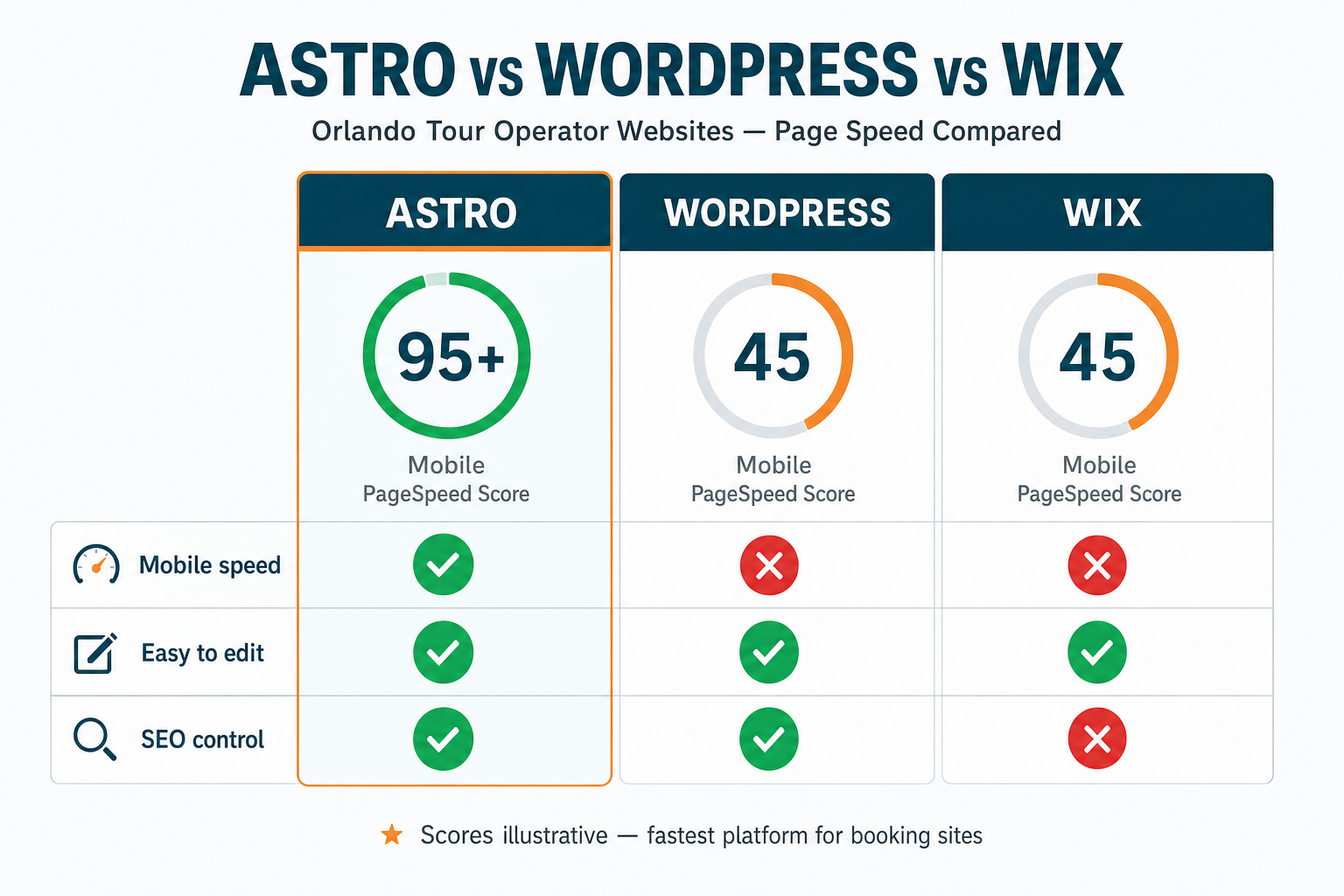
For an Orlando tour operator website, the fastest of the three platforms is Astro — it ships zero JavaScript by default and serves static-first pages from the edge, so it routinely scores 90+ on Google PageSpeed, while a typical WordPress site slows under plugin bloat and Wix carries heavy page-builder overhead. In a market where most of your booking traffic is a tourist standing on International Drive with a phone and three other operators one tap away, that speed gap is the difference between a booked seat and a bounce back to Google.
This is a straight, honest comparison written for tour and activity operators in Orlando and across Central Florida — not a developer flame war. We’ll put real 2026 page-speed and conversion data next to each platform, show what a slow site actually costs a travel business, and end with the practical question that matters: how do you get an Astro-fast site if you’d rather be running trips than learning to code.
Why page speed decides bookings for Orlando tour operators
Travelers don’t browse tour websites the way they browse a laptop at a desk. They’re mid-trip, on a phone, on hotel Wi-Fi or a spotty cellular signal, deciding right now whether to book the airboat ride or the theme-park VIP tour before dinner. In that moment, a slow-loading page isn’t a minor annoyance — it’s an exit.
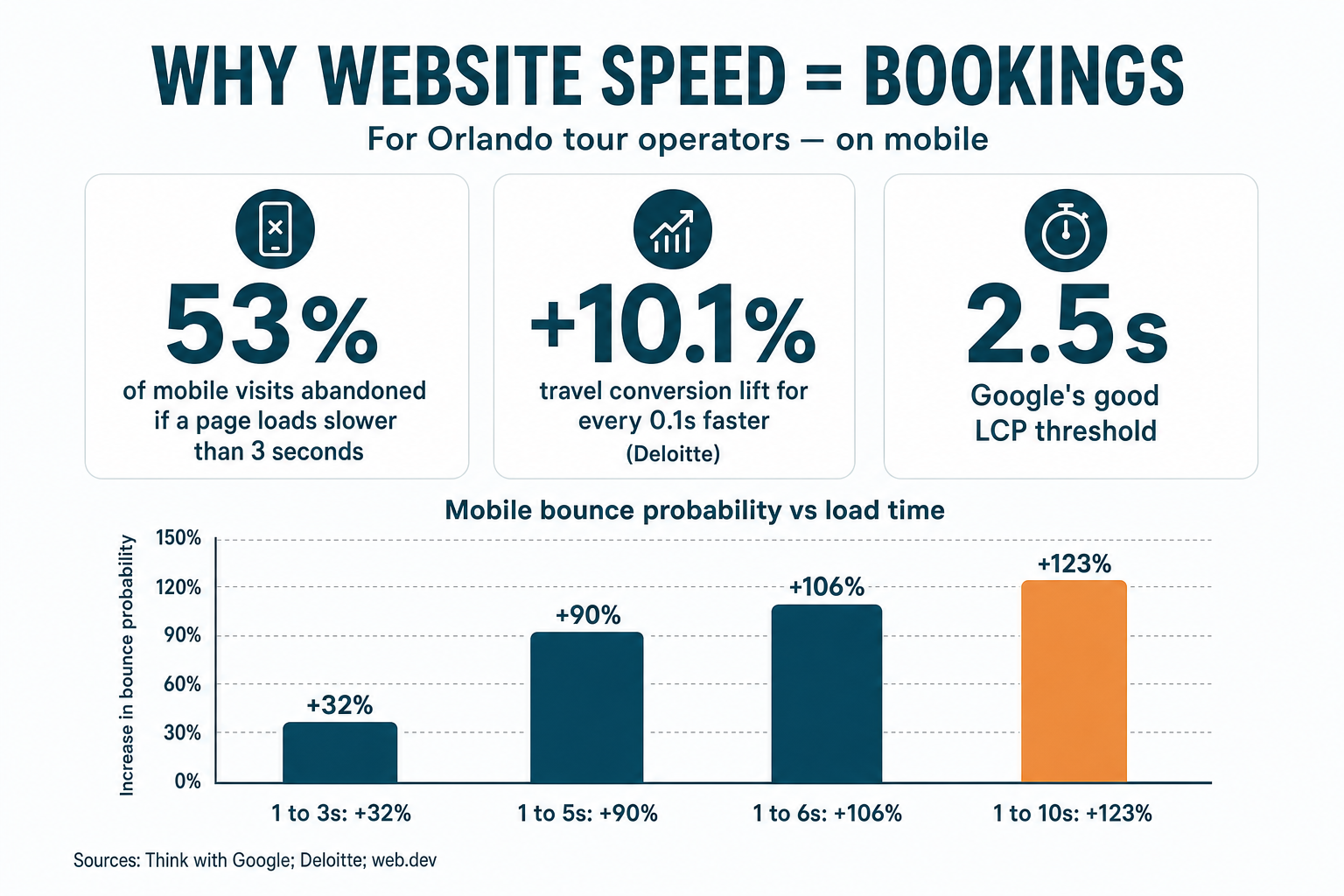
The data is blunt about it. Google found that 53% of mobile site visits are abandoned if a page takes longer than three seconds to load (Think with Google). More than half your mobile visitors are gone before your booking widget even paints — and in Orlando, “gone” means booking with the operator whose page did load.
For travel specifically, the upside of being fast is bigger than in almost any other industry. Deloitte’s Milliseconds Make Millions study, commissioned by Google, found that a mere 0.1-second improvement in mobile site speed increased conversion rates by 10.1% for travel sites — the largest category effect in the study, ahead of retail’s 8.4% (Deloitte via web.dev). Tenths of a second move real bookings when the buyer is a traveler.
The reverse is just as measurable. Google’s research with SOASTA showed that as mobile page-load time climbs, the probability that a visitor bounces climbs with it — +32% going from one to three seconds, +90% at five seconds, and +123% at ten seconds (Think with Google). Every extra second on your tour site is a compounding tax on your ad spend, your Google ranking, and your calendar.
The Orlando context: a fast site is a local edge
Orlando is one of the most-visited destinations in the United States, which cuts both ways for operators. There is enormous demand — but there is also enormous competition for it. When a visitor searches “things to do in Orlando,” “airboat tour near me,” or “Kennedy Space Center guided tour,” they’re shown a wall of options, and they’ll tap the ones that look credible and open instantly on their phone.
Two things follow from that. First, most of your traffic is mobile and impatient — vacationers deciding between activities in a few thumb-taps. Second, you’re competing on Google’s turf, where page speed is not just a user-experience nicety but a documented input to ranking (more on that below). A fast, well-structured site helps you surface in the Orlando local pack and in the “things to do” carousels and converts the visitor once they land. A slow one loses on both ends: it ranks worse and bounces the few visitors it does get.
This is the same local-visibility logic we cover in the local SEO playbook for tour operators — page speed and Core Web Vitals are the technical half of that story. Being found and being fast are the same project.
How Google measures “fast”: Core Web Vitals
“Fast” isn’t a vibe — Google defines it with three measurable metrics called Core Web Vitals, all judged on real-world mobile data at the 75th percentile:
- Largest Contentful Paint (LCP) — how quickly the main content loads. Good: ≤ 2.5 seconds.
- Interaction to Next Paint (INP) — how responsive the page feels when tapped. Good: ≤ 200 milliseconds. (INP replaced FID as a Core Web Vital on March 12, 2024.)
- Cumulative Layout Shift (CLS) — how much the page jumps around while loading. Good: ≤ 0.1.
Source for all three: web.dev — Web Vitals.
These aren’t academic. Core Web Vitals are part of Google’s page experience signals, used by its ranking systems (Google Search Central). Google is careful to say good scores alone won’t rocket you to #1 — content still matters most — but between two comparable Orlando tour pages, the faster, more stable one has the edge. The platform you build on largely decides whether hitting those thresholds is automatic or a constant fight.
Astro vs WordPress vs Wix, head to head
Here’s the honest, at-a-glance comparison for a tour operator site. The theme across the table is simple: the more a platform does automatically for a non-technical owner, the more weight it tends to ship to the browser — and weight is the enemy of speed.
| What matters | Astro | WordPress | Wix |
|---|---|---|---|
| Rendering approach | Static-first, served from the edge | Server-rendered + heavy client JS | Hosted page-builder |
| JavaScript shipped by default | Near-zero (opt-in “islands”) | Grows with every plugin/theme | Heavy builder runtime |
| Typical mobile PageSpeed | 90–100 (by design) | Varies; often 30–60 with plugins | Often 30–60 on content-rich pages |
| Ease of editing for a non-coder | Needs a build/dev (or a managed team) | Familiar dashboard, plugin sprawl | Easiest drag-and-drop |
| Bloat risk over time | Very low | High — plugins compound | Moderate, but capped by the platform |
SEO / schema / llms.txt control |
Full, clean, developer-grade | Good, but plugin-dependent | Limited, templated |
| Hosting | Global edge CDN (cheap/free) | Paid host; performance varies | Locked to Wix |
| Best for | Fast, SEO-first booking sites | Content-heavy sites with a webmaster | Hobby sites / quick DIY |
No platform is “bad.” The right question is what a tour booking site needs: instant mobile loads, clean SEO, and updates that don’t slow it down over a season. On those three, the ranking is consistent — Astro, then WordPress with disciplined maintenance, then Wix.
WordPress: powerful, popular, and prone to bloat
WordPress runs an estimated 43% of all websites on the internet (W3Techs), and for good reason: it’s flexible, familiar, and has a plugin for everything. That last part is also its speed problem.
A fresh WordPress site can be quick. A real tour operator WordPress site — with a booking plugin, a slider, a reviews widget, a chat plugin, an SEO plugin, a page builder like Elementor, and a theme that bundles all of the above — is usually not. Each plugin adds CSS and JavaScript that ships to every visitor’s phone, and it compounds. This is a big part of why the median mobile web page now weighs ~2.3 MB, more than triple its weight a decade ago (HTTP Archive 2024).
WordPress can be made fast — with a lightweight theme, caching, a CDN, image optimization, and someone who maintains all of it. That’s the catch for an operator: the speed is real but it’s a job, and it decays the moment you install the next handy plugin.
Wix: easy to start, hard to make fast
Wix is the friendliest on-ramp of the three. Drag, drop, publish — no host to manage, no plugins to update. For a brand-new operator testing an idea, that convenience is worth a lot, and Wix has genuinely improved its performance over the years.
The ceiling, though, is real. Wix renders through a hosted page-builder that ships a heavy JavaScript runtime to every visitor, and content-rich pages — exactly what a tour site is, full of galleries, itineraries, and booking widgets — often land in the 30–60 range on mobile PageSpeed. You also inherit Wix’s constraints: you can’t move your site off Wix, your control over technical SEO, schema, and files like llms.txt is limited to what the platform templates allow, and you’re on Wix’s roadmap, not your own. For a business whose bookings depend on mobile speed and Google visibility, those ceilings bite.
Astro: fast by default, built to rank
Astro takes the opposite approach to the other two. Instead of shipping a big JavaScript framework and then trying to trim it, Astro ships zero client-side JavaScript by default and renders your pages to static HTML, adding interactivity only where you explicitly ask for it through opt-in components called “islands” (Astro docs). A tour page — hero image, itinerary, reviews, a booking embed — becomes lightweight HTML served from a global edge network, so it paints almost instantly on a traveler’s phone.
That architecture is why Astro sites routinely clear a 90+ Google PageSpeed score, often hitting a perfect 100, on both mobile and desktop — not because of aggressive tuning, but because there’s simply less to load. It also gives you developer-grade control over the technical SEO that tourism ranking depends on: clean titles and meta, proper schema, location pages, and tidy sitemap/robots/llms.txt files that help both Google and AI answer engines understand and cite your tours.
The trade-off is honest: Astro isn’t a drag-and-drop editor you log into and rearrange yourself. It’s a framework, which means you either need development skills or a team that handles the build and your updates for you. Which is exactly the gap the last section is about.
What this means for your Orlando tour business
Put the pieces together and the practical picture for an Orlando operator is clear.
Same tours, two different websites
A plugin-heavy WordPress or Wix site takes 5–6 seconds to load on a tourist's phone. Google ranks it below faster competitors, so fewer people find it. Of those who do, roughly half bounce before the booking widget loads. Your ad clicks land on a slow page and convert poorly. Every seasonal price change means a support ticket and a wait.
An Astro site loads almost instantly, clears Core Web Vitals, and ranks well for 'things to do in Orlando' searches. Travelers land, the page paints before they lose patience, and the booking flow is right there. The same ad spend and the same traffic convert measurably better — because in travel, tenths of a second move bookings.
None of this requires you to become a web developer or to babysit plugins. It requires the right platform underneath — one that’s fast because of how it’s built, not in spite of it — plus someone to handle the build and your ongoing changes so the site stays fast all season.
How to get an Astro-fast tour site without coding
Here’s the honest build-vs-buy: you can learn Astro, wire up your booking embeds, build your location pages, and deploy to an edge host yourself — plenty of technical operators do, and the result is excellent. But if your time is better spent running trips than fighting a build pipeline, the faster path is to have it done for you.
That’s exactly what our Get a Website service is: we build your tour site on Astro, with a guaranteed 90+ Google PageSpeed score (often a perfect 100), proper local SEO and schema for your Orlando destination pages, an AI chat widget, review-collection automation, and managed edge hosting — for $497 one-time + $97/month, with the one-time fee only charged after your site is live and you’re happy. Updates — a new departure, a seasonal price, a new tour page — go through simple support tickets, so the site stays fast and current without you touching code or getting billed by the hour. It pairs naturally with the prebuilt website that ships inside the Tourism Snapshot if you want the full booking-and-automation engine behind it.
Frequently asked questions
Is Astro really faster than WordPress and Wix for a tour website?
For a typical content-rich tour site, yes. Astro ships zero client-side JavaScript by default and serves static-first pages from the edge, so it routinely scores 90+ on Google PageSpeed. WordPress can be fast but slows as plugins accumulate, and Wix ships a heavy page-builder runtime that often lands content-rich pages in the 30–60 range on mobile. The gap comes from architecture — Astro simply sends the browser less to do.
Why does website speed matter so much for Orlando tour operators specifically?
Orlando is a high-competition, mobile-heavy market — most of your buyers are tourists deciding between activities on a phone. Google found 53% of mobile visits are abandoned if a page takes over three seconds to load, and Deloitte measured a 10.1% travel-conversion lift for every 0.1-second speed improvement. In a market where a competitor is one tap away, a fast site both ranks better and converts more of the traffic it gets.
Do I need to know how to code to use Astro?
To build and maintain an Astro site yourself, you need development skills — it's a framework, not a drag-and-drop editor like Wix. Most tour operators prefer a done-for-you build. Our Get a Website service builds and hosts your Astro tour site and handles all your updates through support tickets, so you get Astro's speed without touching code.
What are Core Web Vitals and do they affect my Google ranking?
Core Web Vitals are Google's three page-experience metrics: LCP (main content loads, good ≤ 2.5s), INP (tap responsiveness, good ≤ 200ms), and CLS (visual stability, good ≤ 0.1). They're part of Google's ranking systems, so they influence how you rank — though content quality still matters most. Between two similar Orlando tour pages, the faster, more stable one has the edge.
Can I just make my existing WordPress or Wix site faster instead of switching?
Sometimes. A WordPress site can be sped up with a lightweight theme, caching, a CDN, image optimization, and removing unnecessary plugins — but it takes ongoing maintenance and tends to slow again over time. Wix gives you less room to fix core performance because you're inside a hosted page-builder. If speed and Google visibility are central to your bookings, rebuilding on a static-first platform like Astro is usually the more durable fix.
How much does a fast Astro tour website cost?
Our Get a Website service is $497 one-time plus $97/month, and you only pay the one-time build fee after the site is live and you're satisfied. The monthly covers managed edge hosting, your domain, SSL, and up to 10 support tickets a month for changes. There's an auto-blogging plan at $197/month total and a multi-site bulk option for operators running several destinations.
About the author
Desmond Clarke is a GoHighLevel Agency Strategist based in Savannah, Georgia. He has spent years helping travel and tour brands turn scattered tools — a booking widget here, three spreadsheets there — into one system that actually books trips. He’s opinionated about two things: that a website’s job is to convert, not to win design awards, and that speed is the most under-rated growth lever in tourism marketing. He writes about the unglamorous plumbing — page speed, SEO, automation — that quietly decides which operators fill their departures.
Editorial note: GHL Tourism Snapshot is a GoHighLevel automation and website product, not a travel agency. We don’t sell, book, or guarantee any tour. Statistics are drawn from the cited sources and reflect industry or study averages; PageSpeed figures vary by build and content, and your results will vary with your offer, market, and traffic.
Related posts
- Local SEO for Tour Operators: The Google Business Profile Playbook — the ranking half of the speed-and-visibility story.
- Direct Bookings for Tour Operators: How to Stop Losing 20–30% to OTAs — why a fast site you own beats renting traffic from OTAs.
- AI Chatbot for Tour Operators — the chat widget that turns a fast website visit into a booked seat.
- 6 automations every tour operator should run — where your website fits in the full booking engine.
Want a blazing-fast tour site built for you? See Get a Website, explore the full Tourism Snapshot pricing, or talk to a real person about your Orlando tours.