
It is 8:52am and a family of five is at the dock for the 9am kayak trip. Nobody signed a waiver, so you thrust a clipboard at the dad, he scrawls something without reading it, and you push off late. Six weeks later his kid twists an ankle on the takeout ramp, and a lawyer asks for the signed release. You have a smudged half-signature on a coffee-stained page, and no way to prove the guy read the risks. The fix is a plain, specific waiver that lists the real risks, releases only what the law lets you release, gets signed by every adult guest before the trip through a link that records who signed and when, and lands in your files where you can find it in ten seconds.
A liability waiver, sometimes called a release or an assumption-of-risk agreement, is a contract where a guest agrees to accept the ordinary risks of your activity and not sue you for injuries caused by your ordinary negligence. It is one of the cheapest pieces of protection an operator has, and one of the easiest to get wrong. This is the build-it-yourself version: what goes in it, what it can and cannot cover, and how to collect a signature that stands up.
Why a waiver is worth building properly
Guiding is a physical business. People tip kayaks, sprain ankles on lava rock, and get seasick on a charter. Most of the time nothing happens, which is why operators get lazy about the paperwork, until one bad afternoon makes a single document the difference between a stressful phone call and a business-ending claim. A good waiver does three jobs. It warns the guest, in plain language, that the activity carries real risk, which alone talks a lot of people out of a lawsuit. It records that they accepted that risk on a date. And where the law allows, it releases you from liability for ordinary mistakes, which often ends a claim before a lawyer will take it. With about 62,200 tour and travel guide jobs in the US in 2025 (BLS), it is the paperwork that lets you keep putting strangers in moving boats and on trails.
The six-stage tour waiver system
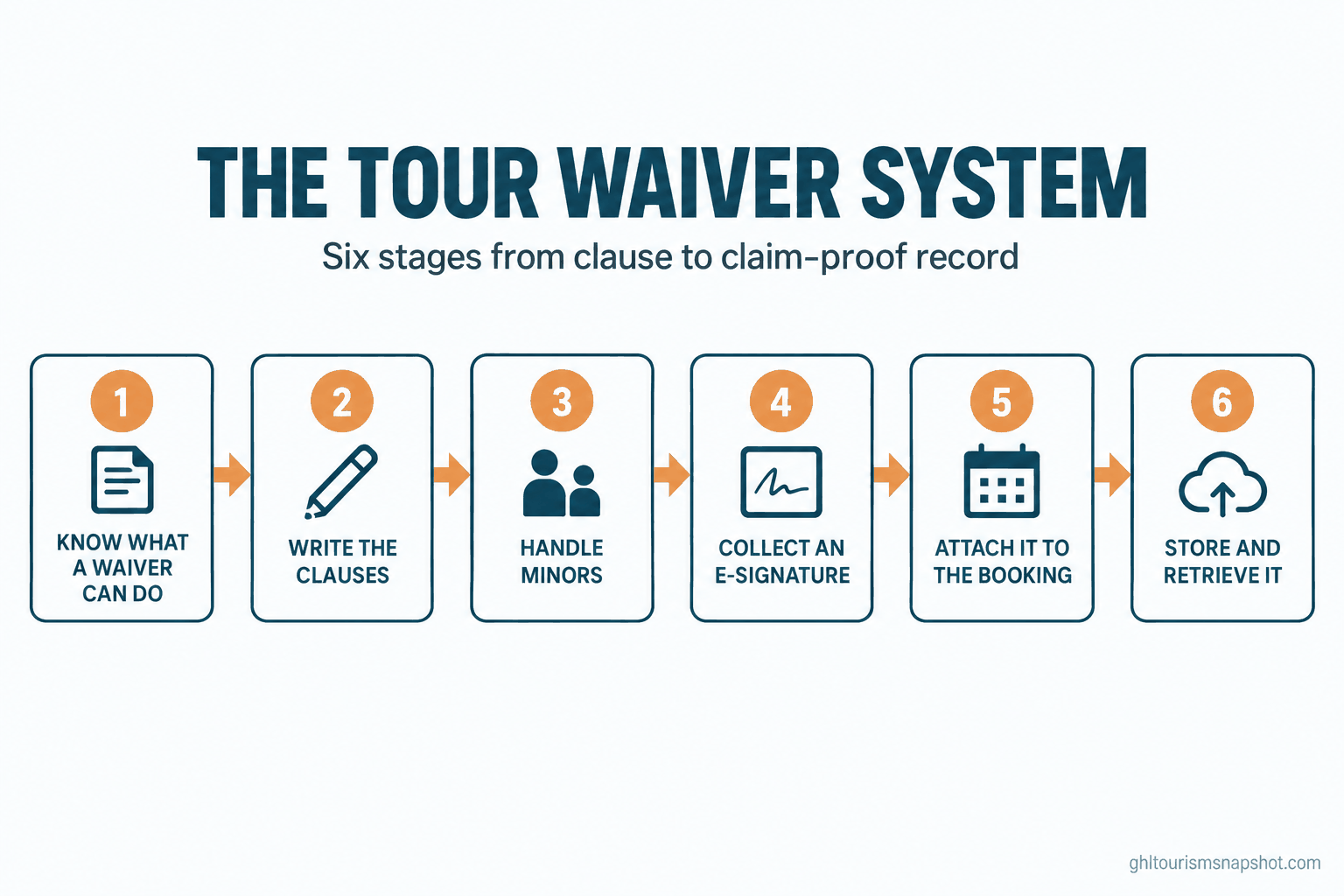
You do not need a law degree to run this well. You need a clear document, a sensible way to collect it, and a place to keep it. Six stages get you there: know what a waiver can and cannot do, write the clauses that hold up, handle minors separately, collect a signature the law respects, attach it to the booking, and store it so the day a claim lands you produce the right version in seconds. The rest of this guide walks through each one.
Stage 1: Know what a waiver can and cannot do
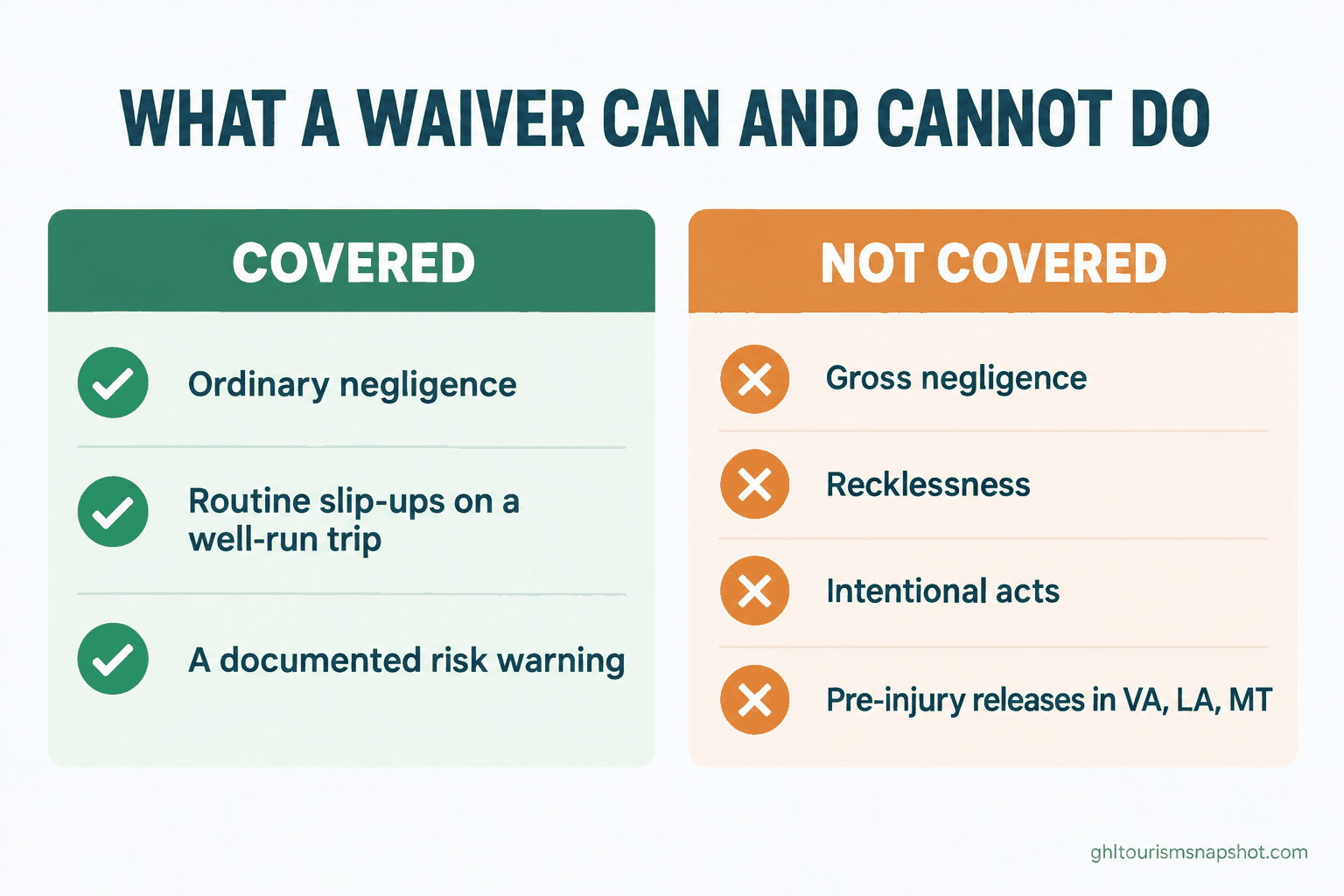
Start here, because most operators overestimate what a signature buys them. A waiver can shift the ordinary risks of your activity onto the guest. Courts in most states enforce a clear, conspicuous release for ordinary negligence, the routine slip-ups that happen in any operation, as long as the language is specific and the guest had a fair chance to read it.
What it cannot do is the heavy lifting people imagine. It gives you no protection against gross negligence, recklessness, or intentional acts (MWL Law). Send a guide out drunk, skip a documented equipment check, run in conditions you were warned off, and the waiver is paper. It is a legal backstop, not a substitute for guide training and good judgment.
Then there is geography. A few states will not enforce a pre-injury release of negligence for personal injury at all: Virginia refuses them on public-policy grounds, Louisiana voids clauses that exclude liability for physical injury, and Montana bars them except for a narrow sports-and-recreation carve-out with strict formatting and bold warning language (LSU Law Review). If you operate in one of those three, collect the waiver anyway as a risk warning, but do not run the business as if it will stop a lawsuit.
Stage 2: Write the clauses that hold up
An enforceable waiver is not long, but it is specific; vague boilerplate is what courts throw out. Getting these parts right is the kind of back-office system that quietly protects a season.
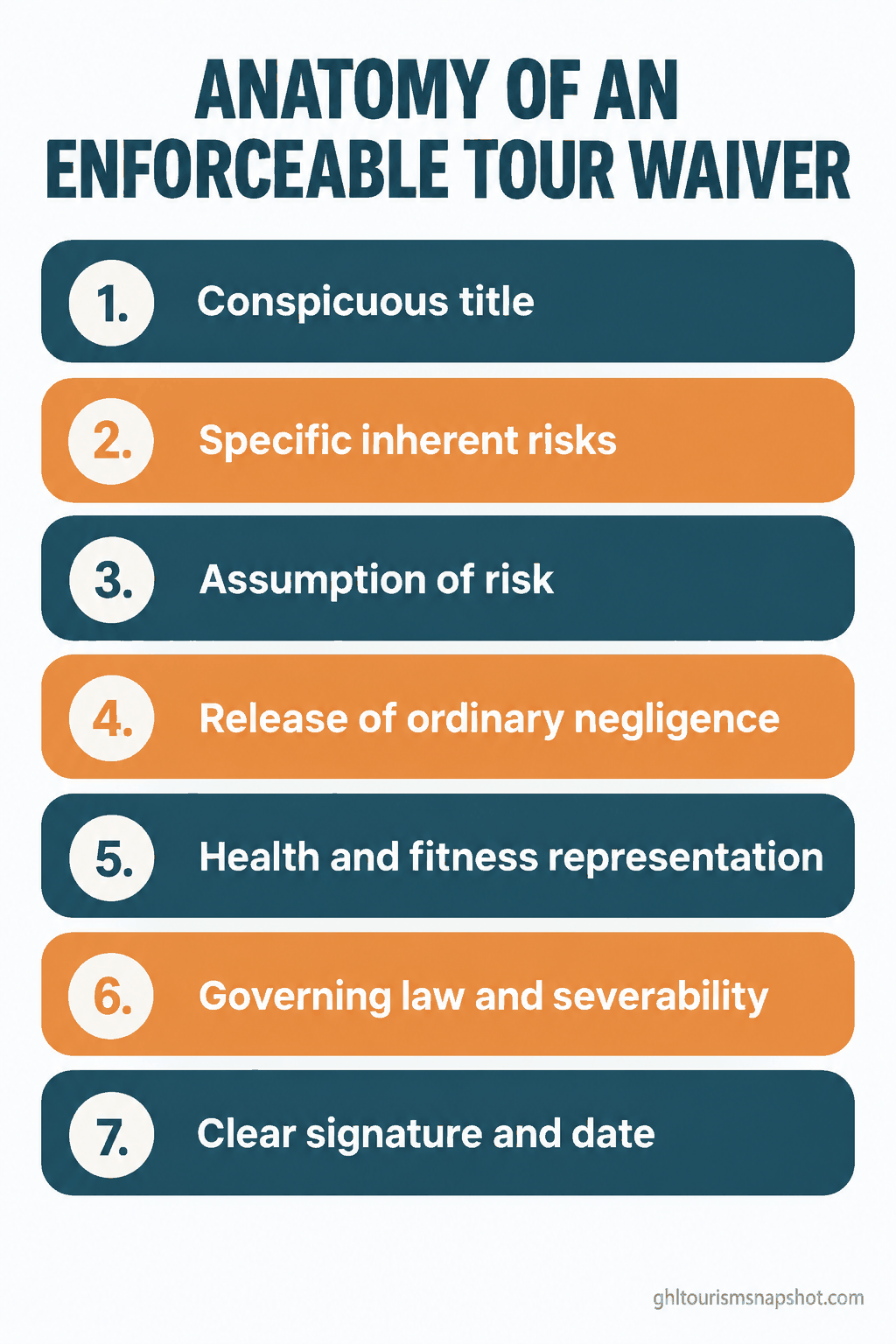
- A conspicuous title. Call it what it is: “Assumption of Risk, Release, and Waiver of Liability.” Courts look at whether the signer knew they were giving something up, so burying the release in fine print works against you.
- A specific list of inherent risks. Name the real ones: capsizing and cold water for kayaking, falls and collisions for cycling, rollover and terrain for ATVs, seasickness and slips for a charter. Generic “activities may be dangerous” language is weak.
- The assumption of risk. The guest states they understand these risks and take part anyway. In some states this survives even where the release clause does not.
- The release of ordinary negligence. The guest agrees not to sue you for injury from your ordinary negligence. Keep it plain, and never stretch it toward gross negligence, which courts will not honor.
- A health and fitness representation confirming the guest can participate and has disclosed relevant conditions, which matters for strenuous or water-based tours, plus a media release for trip photos and video.
- Governing law and severability. State which state’s law applies, and add that if one clause is struck down the rest survives. That severability line saves the document when a single sentence is challenged.
- A clear signature and date, with a box confirming they read and understood it.
How this breaks: an operator copies a template built for a gym, never lists the real risks of a whitewater trip, and a court decides the guest was never meaningfully warned. Write the risks in your own words and have an attorney review the release once.
Stage 3: Handle minors, because the rules change
Here is the part that surprises operators running family tours: in many states, a waiver a parent signs on behalf of their child is not enforceable. Roughly 17 states, including Texas, Washington, Pennsylvania, and Illinois, reject parent-signed pre-injury waivers for minors, while California, Colorado, and Florida generally uphold them (Sportwaiver). A parent generally cannot bargain away a child’s legal rights before an injury has happened.
Approximate number of US states by how their courts treat a pre-injury waiver a parent signs for a minor child. Source: Sportwaiver.
So what do you do? Collect the parent’s signature anyway; it still documents informed consent and warns the family. Add a parental indemnification clause, where the parent agrees to cover claims brought on the child’s behalf; some states honor the indemnity even when they will not honor the release. And if you run kid-heavy tours in a state that voids these waivers, that is a conversation for your insurance broker.
Stage 4: Collect a signature the law respects
A digital waiver, signed before the guest arrives, is easier to run and easier to defend than a paper one scrawled at the dock, and the law is settled: electronic signatures are as valid as ink.
Two laws make that true. The federal ESIGN Act of 2000, at 15 U.S.C. 7001, says a signature or record “may not be denied legal effect, validity, or enforceability solely because it is in electronic form” (Cornell Law, NCUA). The UETA, adopted by 49 states plus DC, says the same at the state level (Uniform Law Commission); New York uses its own law to the same effect.
To make an e-signature stand up, four things have to be true, and a decent digital waiver tool handles all of them: intent to sign (a deliberate action like typing a name), consent to sign electronically (usually a checkbox), attribution (a captured timestamp, IP, and email that tie the signature to the person), and record retention (the signed record stored and reproducible later).
The practical upgrade over paper is the metadata. A digital waiver captures who signed, when, from what device, and against which version of your document. That timestamped trail proves the guest signed before the trip and saw the exact language you rely on, which is worth more in a dispute than any physical signature.
How this breaks: an operator emails a PDF and asks guests to “print, sign, and bring it,” which nobody does, so half the manifest is unsigned by departure. Use a real signing flow, not an attachment and good intentions.
Stage 5: Attach the waiver to the booking
A waiver only protects the guests who sign it, so the whole game is getting 100 percent of the manifest signed without turning your morning into a chase. Bolt it onto the booking flow instead of treating it as a separate errand.
The pattern that works: the moment someone books, they get a confirmation with the waiver link, and the booking is not fully “ready” until it is signed. Still unsigned 24 hours out, an automated reminder goes out, the same reminder logic that cuts no-shows. One signed waiver per guest, not per booking, because a party of six needs six adult signatures, not one from whoever paid.
This is where a connected booking and CRM setup earns its keep. Your appointment and booking automation sends the waiver with the confirmation, your CRM tags the contact as “waiver signed” or “waiver pending,” and the check-in list shows at a glance who still needs to sign. The guest signs from the couch the night before, and you start on time with a complete manifest.
Stage 6: Store it so you can find it fast
A signed waiver you cannot find is barely better than no waiver. When a claim lands, sometimes a year or more later, you need to produce the exact document that guest signed, on the date they signed it.
Three rules keep you covered. Store every waiver against the guest and the trip date, not in a shared inbox or a shoebox of clipboards. Version your waiver, so if you update the language you can still pull the exact version a past guest agreed to. And keep them as long as a claim could be filed, which is your state’s statute of limitations for personal injury, often two to four years and longer for minors, so ask your attorney what fits.
How this breaks: signed PDFs pile up in an email folder with no link to the booking, and a lawyer’s request for one specific waiver becomes a day of scrolling. A CRM that files each signed waiver on the contact record turns that search into a two-click export, so store by guest and trip from day one.
Steal these: the exact messages and clauses
Here is language you can adapt today. Run the clauses past your own attorney before publishing, but this is the shape of a working set.
Sample assumption-of-risk and release clause (adapt with a lawyer):
“I understand that [activity, e.g. guided sea-kayaking] involves real and inherent risks, including but not limited to capsizing, cold-water immersion, weather changes, collisions, and slips. I voluntarily accept these risks. To the fullest extent allowed by law, I release [Operator Name] and its guides from liability for injury or loss caused by their ordinary negligence. I have read and understood this document and sign it freely.”
Booking-confirmation message with the waiver (SMS):
“You’re booked for the 9am Harbor Kayak Tour on Sat! One quick thing before you paddle: every adult needs to sign our short waiver. Takes 60 seconds: [link]. See you at the dock. Reply STOP to opt out.”
Reminder to the unsigned, 24 hours out (SMS):
“Reminder: your kayak trip is tomorrow at 9am and we still need your signed waiver so you can get on the water. Sign here: [link]. Message us if the link gives you trouble.”
Dock script for a walk-up who has not signed:
“Great, let’s get you on this trip. Before the safety briefing I just need you to sign our waiver. It lists the risks and confirms you’re good to paddle. Easiest way is right here on this tablet, takes a minute.”
Solo, mid-size, and large: scaling the system
The same six stages run differently by size.
The solo operator or independent contractor. Keep it lean: one well-drafted digital waiver, sent with every booking confirmation, signed on a phone. If you contract under a host agency, ask whose waiver governs and whether you are named on it; do not assume the host’s release covers you personally.
The mid-size team. With several activity types and seasonal guides, you need per-activity risk language, because a food tour and a zip-line do not share the same risks, plus a check-in view showing each guide who still has not signed. Give guides a 30-second rule: no signature, no boarding. Consistency across guides breaks first, so make the unsigned list impossible to miss.
The large or multi-location operator. Multiple locations or charters mean multiple state laws in play, which is where the Virginia, Louisiana, and Montana problem and the minor-waiver map matter most. You need location-specific versions, centralized storage so any office can pull any record, and a documented retention schedule. Here the metadata and versioning from Stage 4 become the difference between a defensible program and a liability you cannot audit.
Common objections
“Won’t a scary waiver kill my bookings?” A clear waiver signed at booking barely registers; travelers sign them for any activity with risk. What costs you bookings is a clipboard shoved at nervous first-timers at the dock. Move it upstream and keep the language plain.
“Do e-signatures really hold up? Why not stick with paper?” They hold up. Under ESIGN and UETA an electronic signature carries the same weight as ink, and the captured timestamp and version data usually make it easier to defend than paper, which loses proof of when it was signed and caps you at whoever remembers the clipboard. Use a tool that captures intent, consent, and a timestamp, not a PDF emailed back.
“Do I need a lawyer, or can I use a template?” Use a template as a starting draft, then pay a local attorney for one review. It is a small, one-time cost, and they will catch the state-specific wording, the minor-waiver issue, and the governing-law clause a generic template gets wrong. Pair this with the rest of your operator compliance checklist.
Frequently asked questions
Are electronic signatures legally binding on a tour waiver?
Yes. Under the federal ESIGN Act and the UETA adopted by 49 states plus DC, an electronic signature cannot be denied legal effect just for being electronic. To be defensible it needs intent to sign, consent to sign electronically, attribution to the person, and a stored, reproducible record. A real signing flow with a captured timestamp meets that far better than a PDF emailed back.
Does a signed waiver stop a guest from suing me?
No document stops someone from filing. A clear waiver makes many claims not worth pursuing, and in most states it can defeat a claim based on your ordinary negligence. It gives you no protection against gross negligence, recklessness, or intentional acts, and it is not enforceable for personal-injury negligence in Virginia, Louisiana, or Montana.
Can a parent sign a waiver for their child on a tour?
They can sign, but in roughly 17 states courts will not enforce a parent-signed pre-injury waiver for a minor. Collect it anyway for the risk warning and informed consent, add a parental indemnification clause, and talk to your insurer about your exposure on kid-heavy tours.
How long should I keep signed waivers?
At least as long as someone could file a claim, which is your state's personal-injury statute of limitations, often two to four years and longer for minors. Store each waiver against the guest and trip date, version your document, and ask your attorney for the retention window that fits your activity and state.
Is a waiver a substitute for liability insurance?
No. The waiver handles ordinary negligence where the law allows it; insurance covers what the waiver cannot, including gross-negligence claims and the states that void releases. Run both, and lean harder on insurance where waivers are unenforceable or you run tours for minors.
The waiver is not the exciting part of running tours, but it is one of the few pieces of paper that can save the business on a bad day. Build it once with a lawyer, collect it digitally with every booking, and store it where you can find it. A coffee-stained clipboard becomes a system that quietly protects every departure.