
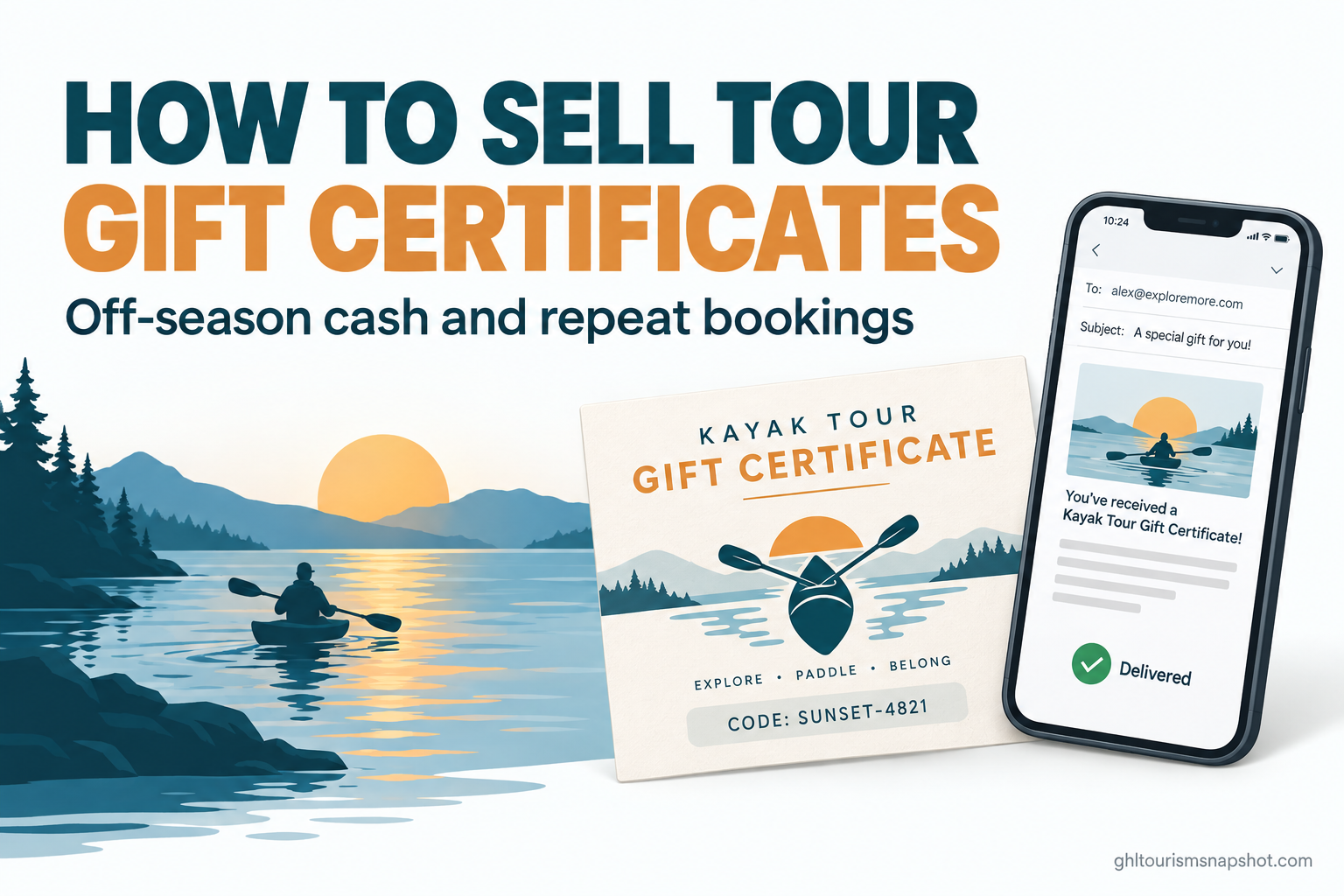
It is a gray Tuesday in mid-November. The boat is on the trailer, the last tour ran three weeks ago, and your bank balance is doing that thing it does every winter. Then the phone buzzes. “Hi, do you sell gift cards? I want to get my dad the sunset kayak trip for Christmas.” You say yes, take a card over the phone, and scribble it on a sticky note. That one sale did three things at once: cash in your worst month, a trip locked in for next season, and a brand-new customer, the person who redeems it. This post is the full system for doing that on purpose, without the sticky note.
What a gift certificate is really worth to you
Most operators treat a gift certificate as a favor for the guest who asks. One sale actually does three things at once.
First, timing. The money arrives in November and December, when departures have dried up and fixed costs have not. You can sell certificates hard, because the buyer is shopping for a gift, not a trip. Gift cards are the second most popular holiday gift, and 43% of shoppers plan to buy at least one this season. (NRF)
Second, the customer. A trip someone buys for themselves is one customer. A gift certificate is two: the buyer, and the recipient, who walks your dock next season. That recipient is the prize, a direct booking with no online travel agency skimming a fifth off the top.
Third, the direction of travel. The US Bureau of Labor Statistics projects 0% employment growth for travel agents through 2035, against 6% for tour and travel guides. (BLS, guides) (BLS, agents) A gift certificate is the purest direct sale: prepaid, 100% yours, never touched a listing site.
One catch up front. A certificate you have sold is a liability, not pure profit. Stage 2 and Stage 6 handle that, because getting the compliance and tracking wrong is the one part of this that can hurt you.
The seven stages, start to finish
A gift-certificate program is a short pipeline, and each stage has a right way plus a few ways it quietly breaks. Here are the seven, from the first decision to the repeat booking a year later.
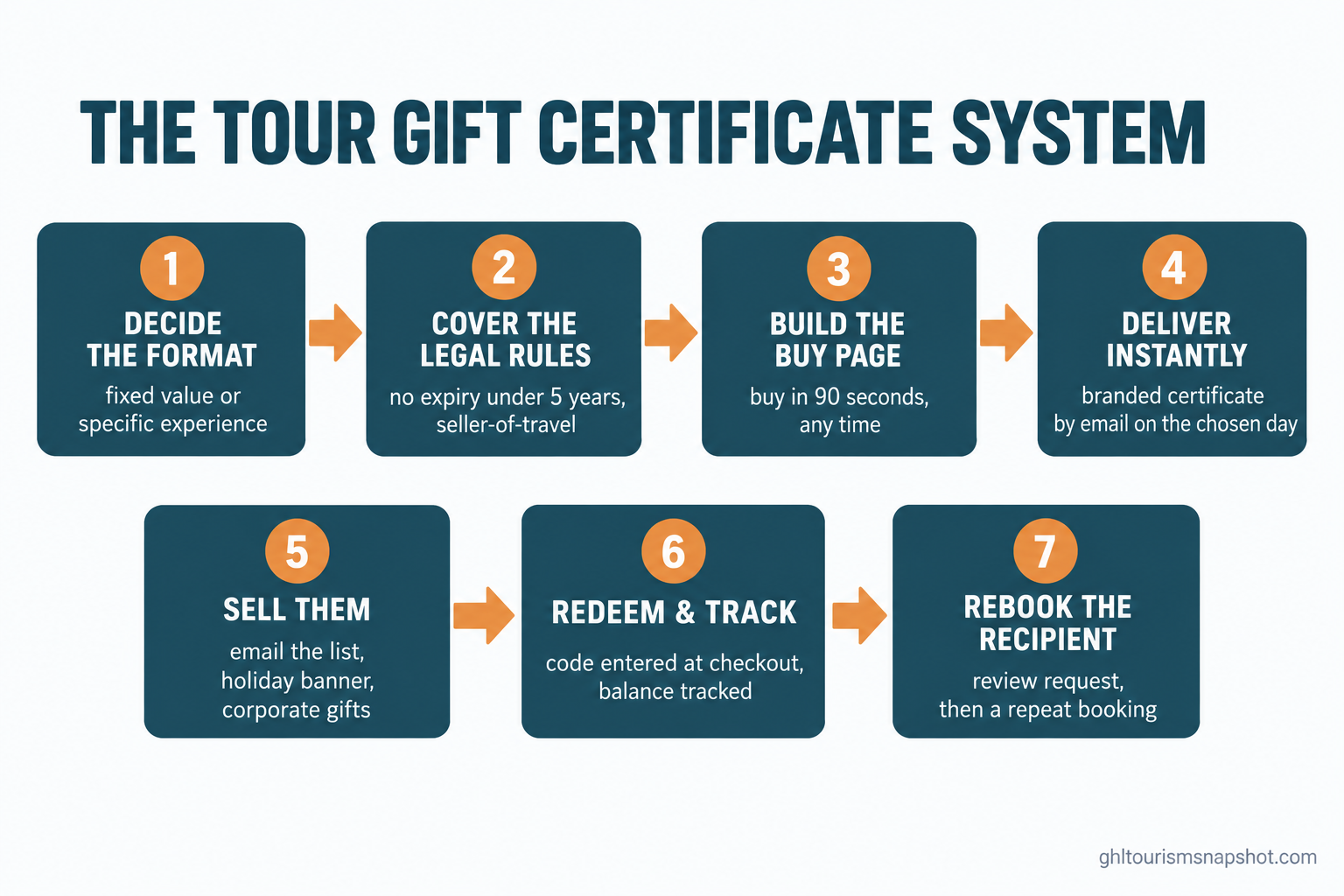
Stage 1: Decide the format and the price
Before you take an order, decide what you are selling. A fixed-value certificate is worth a dollar amount, say $100, toward any tour. An experience certificate is for a specific trip, “one Sunset Kayak Tour for two.” Experience certificates sell better as gifts, because the buyer is giving a thing, not homework.
| Fixed-value certificate | Experience certificate | |
|---|---|---|
| What the buyer picks | A dollar amount | A named tour |
| How it reads as a gift | “Here is $100 toward a tour” | “I booked you the sunset kayak trip” |
| Price changes | No problem, it is a balance | A trip you must honor at that price |
| Redemption | Any tour, any date | That tour, subject to availability |
| Best for | Many tour types and prices | One or two signature tours |
| Main risk | Feels like a coupon | Price creep if redeemed much later |
On price, do not discount. A certificate is a gift, not a deal, so sell at face value. For a holiday push, add value instead: “buy a $150 certificate, we’ll make it $175.” That protects your real price without training buyers to wait for sales.
Stage 2: The legal part you cannot wing
This is the stage operators skip, and the only one that can bite. The rules are short, but a notebook of homemade certificates ignores most of them.
Expiration and fees. If you sell a certificate for money, federal law treats it like a gift card. Under the CARD Act rules, it generally cannot expire for at least five years, and you cannot charge an inactivity fee in the first twelve months. (CFPB) So “expires in 90 days” is not legal on a paid certificate. Some states go further: California effectively bans expiration on most gift certificates, and New York blocks it within nine years. Check your state before you print a date.
The seller-of-travel trap. A handful of states regulate anyone who sells travel, and a certificate for a future trip can fall under those rules depending on wording. Florida’s “vacation certificate” definition is broad: any advance travel purchase where the buyer is entitled to travel or facilities with “no specific date or dates for its use.” (Florida Statutes 559.927) It carves out trips with exact dates paid in full at purchase, so a dated booking is usually fine, but an open-ended “good for one tour, book anytime” certificate is what the statute describes. In Florida, registering costs $300 a year, and offering vacation certificates pushes your required surety bond from $25,000 to $50,000. (FDACS) California requires registration too, and the number has to appear in your advertising. Know your state’s rule first, and lean toward certificates redeemed into a real, dated booking.
This is not legal advice, and the rules vary by state (Washington, Hawaii and Iowa are also often cited), so spend twenty minutes confirming yours. Our seller-of-travel registration guide covers who has to register and the advertising-disclosure rule that catches operators off guard.
Stage 3: Build a real buy page
The sticky note has to go. Taking orders by phone does not scale, it is a security risk, and every sale needs you personally. The fix is one page on your own site where anyone can buy a certificate in ninety seconds, any time of day.
A working buy page needs five things: a clear headline, the certificate options, a field for who it is for and a personal message, a “deliver on” date, and a checkout that fires everything off automatically. When the payment clears, the certificate should generate a unique code, email the right person on the right day, and log the sale and the outstanding balance, all without you touching it.
Stage 4: Deliver it the second they pay
Delivery is where a certificate earns its reputation as the easy gift. The buyer buys at 11pm and a polished certificate lands in the recipient’s inbox at 7am on the chosen morning. Buying for tomorrow? It arrives instantly. Want to hand it over in person? There is a printable version too.
A bare code in a plain email reads like spam. A branded certificate with the tour photo, the buyer’s message, the code, and one obvious next step reads like a real gift. Keep the instruction to one line.
The same engine sends the buyer a receipt and a delivered-on confirmation. For the messages that pair with this, our tour booking message templates post has the confirmations, reminders and review asks written out.
Stage 5: Actually sell them
A buy page nobody sees sells nothing. For six weeks a year, point everything at it. The audience is your past guests buying for someone else, plus anyone landing on your site in gift-shopping mode.
Run three plays. First, email your list in mid-November and again in early December; these people took your tour and loved it, which makes them your best gift sellers. Second, put the certificate everywhere a holiday shopper looks: a homepage banner, your email signature, a pinned social post. Third, chase group and corporate gifting, the quiet whale here. A company buying twenty certificates for a staff gift is one email and a far bigger ticket than twenty shoppers.
One rule on texting. Promote by SMS and you still need proper consent and registered business texting; a holiday blast to a cold list is how operators get their number filtered. Our A2P 10DLC guide covers how to stay deliverable.
Stage 6: Redeem without losing track
Redemption is where the sticky-note system collapses. Every certificate is money you owe later, and you need to know at any moment how much is outstanding and whether a code is valid, half-used, or spent. By hand across a season, you will double-honor a code or turn away a real guest.
The mechanics are simple when the system tracks them. The recipient books and enters their code. On a fixed-value certificate, the balance comes off and any remainder stays on the code; on an experience certificate, it covers that trip and marks itself redeemed. Your pipeline logs it, drops the liability off your total, and tags that person as a first-time guest so the rebook can start. A proper appointment and booking automation setup handles the balance math and availability for you.
Stage 7: Turn the recipient into a repeat guest
This is the stage that separates operators who dabble from operators who build a real channel. The recipient just took your tour on someone else’s dime. They are warm, on your list, and cost you nothing to acquire. Let them walk off and never hear from you again, and you threw away the best part of the program.
Treat them like a first-time paying guest. When their trip is marked complete, the review request goes out while it is fresh. A week later, a thank-you with a reason to come back: a shoulder-season date or a bring-a-friend offer. One gifted trip becomes a reviewer and a repeat booking for years. Our post on turning one-time guests into repeat bookings has the full sequence, and the whole thing is a textbook direct-booking play with no commission attached.
Three operators, three gift-certificate plays
The system is the same for everyone. The scale and emphasis change with your business.
The solo kayak or walking-tour operator. One or two trips, and you are the whole crew. Keep it dead simple: one or two experience certificates, a single buy page, instant delivery, and a reminder sequence you set up once. You are capturing the “do you sell gift cards?” calls you already get every December and turning them into real off-season cash.
The mid-size shop with several tour types. A few guides, tours at different prices, a real email list. Fixed-value certificates fit better because prices vary, and the list is your engine. Two emails to past guests, a homepage banner, and one push to local businesses will move real volume. Redemption tracking has to be automated now, because you cannot eyeball balances across several guides.
The multi-tour or multi-location operator. Certificates are a line of business, not a favor. You want both formats, corporate and group gifting as its own channel, and tight reporting on outstanding liability. The rebook is where scale pays off: hundreds of recipients a season, each nudged automatically toward a direct repeat booking.
Run the math before you call this small. Forty certificates at an $85 tour is $3,400 in a dead month; 150 at $110 clears $16,500; 500 at $120 is $60,000. For context, the average US gift card runs about $53. (NRF)
Objections, answered straight
“Won’t gift certificates cannibalize full-price bookings?” No. The buyer and the guest are different people. The December buyer was never booking that week for themselves, and the recipient would not have found you at all. You are not discounting a sale you would have made; you are creating one, plus a new customer, in a month you normally sell nothing.
“Isn’t this a huge liability on my books?” It is, which is why Stage 2 and Stage 6 matter. An unredeemed certificate is money you hold now against a trip you owe later, which is healthy as long as you track what is outstanding. And nearly half of Americans are sitting on at least one unused gift card, voucher or store credit right now. (Bankrate) Want them redeemed anyway, because a redeemed certificate becomes a repeat guest.
“I’m not technical. Isn’t a buy page a big project?” It is the part you should not hand-build. It is a solved problem: a purchase page, a payment connection, and an automation that generates the code and emails it. You fill in your tours and prices and turn it on. If building it is the blocker, a done-for-you setup handles it in an afternoon of your input.
FAQ
Can a tour gift certificate expire?
If someone paid for it, generally not for at least five years under federal law, and no inactivity fee in the first twelve months. Some states are stricter: California effectively bans expiration on most gift certificates, and New York blocks it within nine years. Only a free, promotional certificate can expire sooner, so check your state before printing a date.
Do I need a seller-of-travel license to sell gift certificates?
It depends on your state and the wording. California and Florida regulate sellers of travel, and an open-ended certificate for future travel can fall under those rules. Florida's 'vacation certificate' definition is broad and raises the required surety bond. Certificates that redeem into a specific, dated booking are lower-risk. Confirm your state's rule before you launch.
When is the best time to sell tour gift certificates?
Mid-November through late December is the bulk, since gift cards are the second most popular holiday gift. But keep the buy page live year-round for birthdays, anniversaries, and last-minute gifters. The holiday push is a campaign; the page itself is always on.
What happens to the leftover balance on a partly used certificate?
On a fixed-value certificate, the unused balance should stay on the code for the next booking, which only works if your system tracks balances automatically. Otherwise you lose track of partial redemptions and frustrate guests. Experience certificates avoid this, since they cover one named trip.
How do I turn a gift recipient into a repeat customer?
Treat them like a first-time paying guest. Send a review request the moment their trip ends, a thank-you with a reason to come back a week later, then fold them into your off-season win-back sequence. They cost nothing to acquire and book directly, so they are among your most valuable guests to keep.
Back to that gray Tuesday in November, but next year it looks different. The phone still buzzes with “do you sell gift cards?”, but now you say “yes, grab one on our website, it’s delivered instantly,” and go back to loading the trailer. The buy page takes the order, the certificate lands in the right inbox on Christmas morning, and in June a stranger walks your dock holding a code, takes the best tour of their year, and books the next one themselves. That is a gift certificate program: cash when you need it, a customer you never had to chase, and a trip you are proud to run.