
If you run tours in San Antonio and you already own GoHighLevel, your problem probably isn’t the software — it’s that nobody is running it. A GoHighLevel VA for San Antonio tour operators is a trained specialist who lives inside your GHL account and does the daily work the platform can’t do on its own: replying to River Walk and Alamo-tour inquiries within minutes, chasing deposits, firing pre-trip reminders, answering every Google review, and re-booking last season’s travelers — so the system you paid for actually fills departures instead of quietly leaking them.
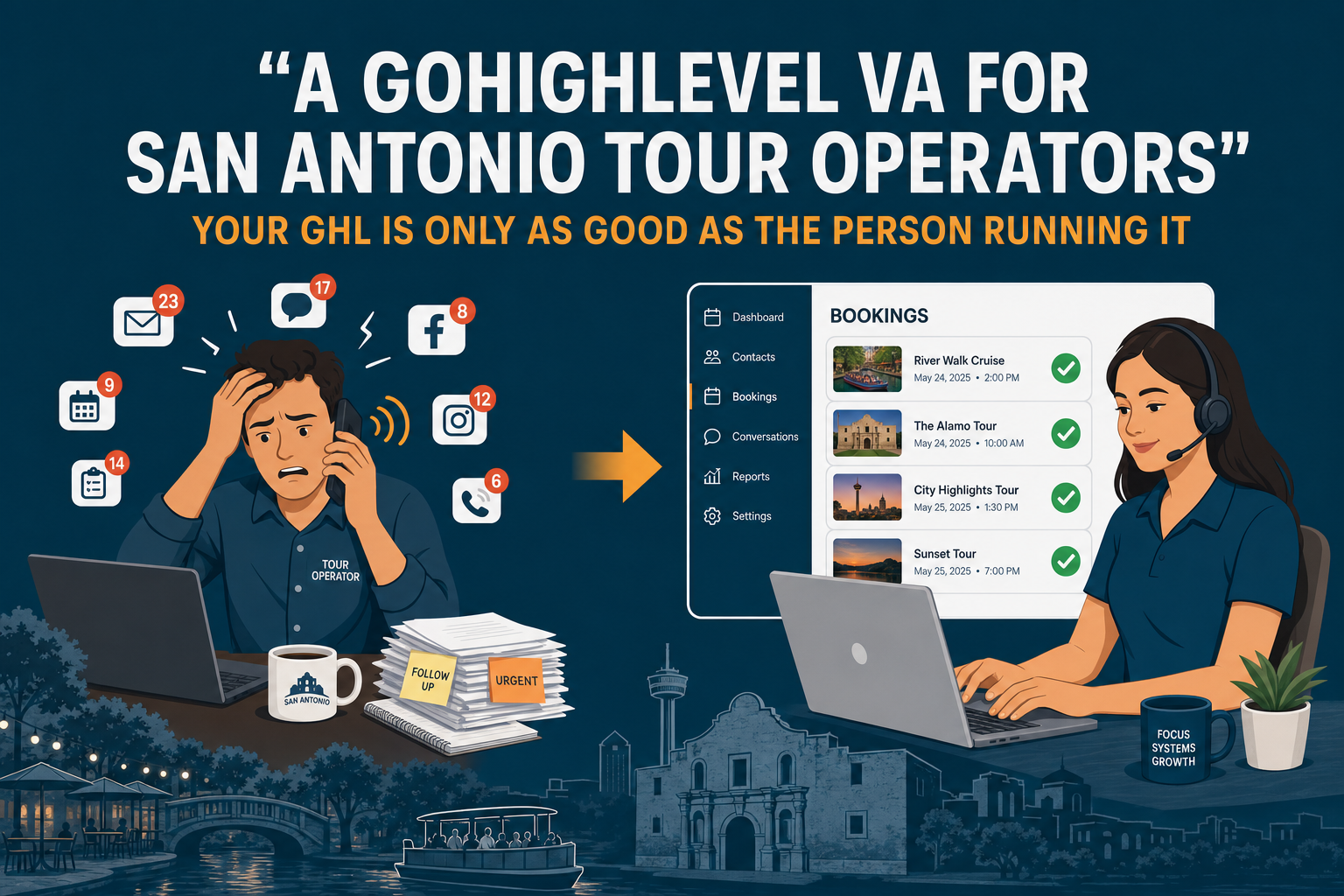
This is the honest, operator-to-operator version of the pitch: what an unmanaged GoHighLevel actually costs a San Antonio tour business, backed by real 2026 data, and what changes the day someone competent takes the wheel.
What is a GoHighLevel VA for tour operators?
A GoHighLevel VA is a virtual assistant trained specifically to operate the GoHighLevel platform — the CRM, pipelines, calendars, workflows, SMS, email, and review tools — on your behalf. For a tour operator, that means someone who treats your GHL account like a booking engine that needs a driver: they watch the pipeline, respond to inquiries, keep automations firing, fix what breaks, and tell you what to automate next.
Here’s the uncomfortable truth most operators discover a month after buying GoHighLevel (or a done-for-you snapshot): the platform automates the machine, but it doesn’t run the business for you. Someone still has to reply to the messages the automation can’t, approve the review responses, adjust a departure time, chase the deposit that didn’t clear, and re-engage the traveler who went quiet. When that “someone” is you — already guiding trips, managing guides, and answering the phone at the meeting point — the system slowly falls out of tune. Leads sit. Reminders misfire. Reviews pile up unanswered. The snapshot you bought to fill departures becomes another dashboard you feel guilty about not checking.
A GHL VA is the missing driver. And in a market as competitive as San Antonio, that difference is measured in booked seats.
The San Antonio context: huge demand, thin margins for error
San Antonio is one of the most-visited destinations in Texas, and the numbers are staggering: the metro welcomed 37.65 million visitors in 2023, whose spending created a $21.5 billion economic impact and supported more than 147,000 local jobs, according to Visit San Antonio. By the 2024 hospitality report, that impact had climbed to a record $23.4 billion — the highest ever for the city.
That demand is a gift and a trap. A gift because a River Walk cruise, an Alamo history walk, a Missions bike tour, a Southtown food crawl, or a downtown ghost tour never runs short of interested travelers. A trap because you are one tap away from a competitor on every search result, every map pin, and every “things to do in San Antonio” list — and travel discovery has gone fully local and mobile. Google reports that searches for destination activities keep climbing, with “things to do” plus a “near me” qualifier growing 6× in two years (Think with Google).
So the traveler finds you at 9 p.m. while planning tomorrow, fills out your form or fires off an Instagram DM — and then what? If your GoHighLevel is unmanaged, the honest answer is: nothing, until you get to it. And by then they’ve booked the operator who answered first.
The five leaks of an unmanaged GoHighLevel
When no one is actively running your GHL, the losses aren’t dramatic — they’re quiet and constant. Here are the five leaks that drain a San Antonio tour operator’s calendar, and the data behind each.
1. New inquiries sit while the traveler books elsewhere
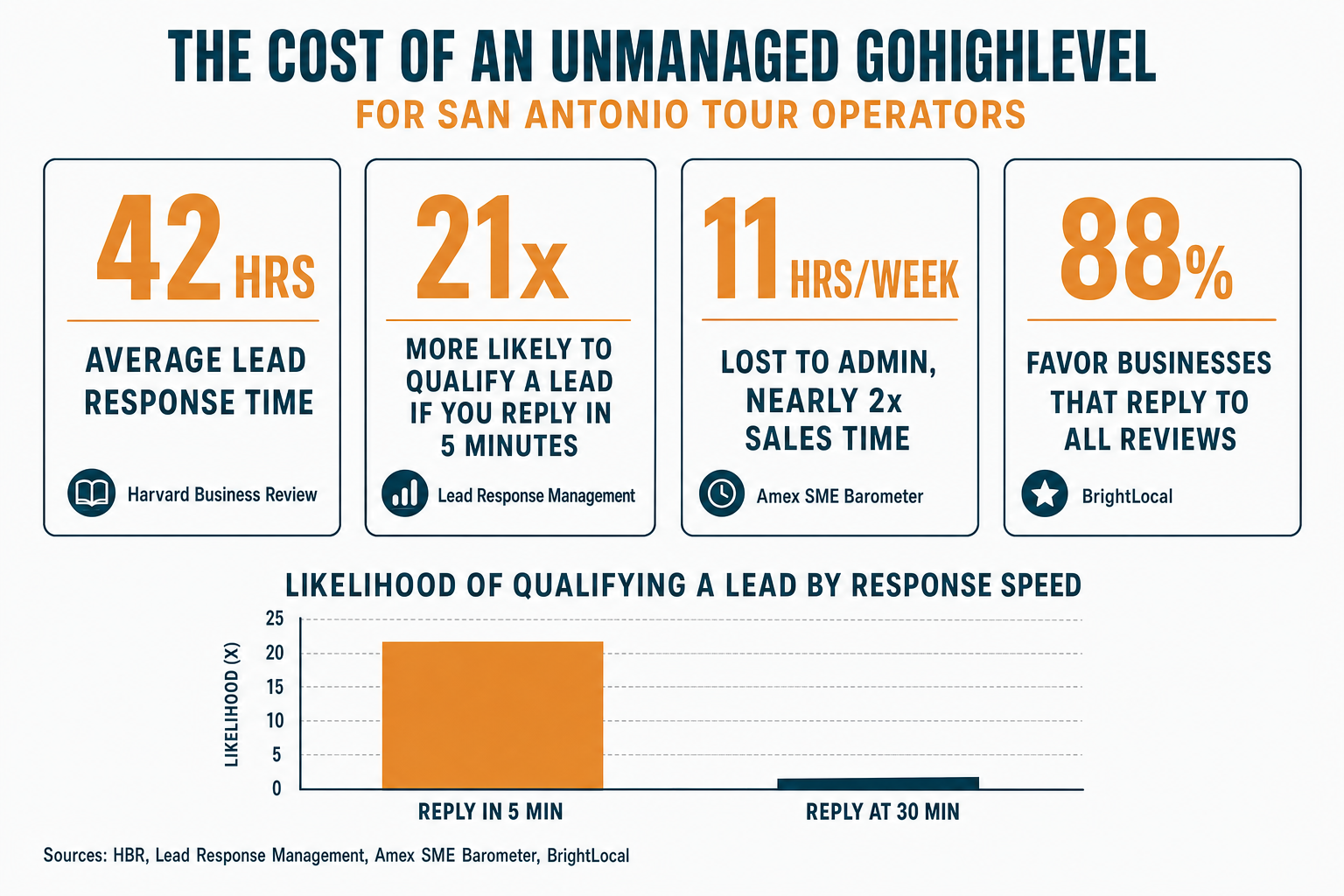
This is the biggest and most expensive leak. Speed-to-lead is not a marketing buzzword; it’s the single most-studied number in sales. Firms that reach a lead within an hour are about 7× more likely to have a qualifying conversation than those who wait even a little longer — yet the average first response across companies is 42 hours, and 23% of inbound leads are never contacted at all (Harvard Business Review).
It gets sharper the tighter you zoom in. The Lead Response Management study found that contacting a web lead within 5 minutes rather than 30 made you 21× more likely to qualify that lead (Lead Response Management). For a tour operator, a “qualified lead” is a traveler about to put down a deposit. An unmanaged GHL that replies tomorrow morning is competing against operators whose VA replied before the traveler closed the browser tab.
2. Reviews go unanswered, and the next traveler notices
Your Google reviews are a storefront, and an unmanaged inbox never replies to them. That’s a problem because review responses now influence the booking decision directly: 88% of consumers favor a business that responds to all of its reviews, compared with just 47% for a business that never responds (BrightLocal). A tour operator with 200 five-star reviews and zero replies is leaving trust — and ranking — on the table. A GHL VA turns review responses into a daily habit and routes the occasional negative review to you privately before it festers in public.
3. Reminders and deposits don’t fire, so no-shows climb
No-shows are the quietest loss in travel: the seat was sold, then vanished, and you can’t resell it. The fix is a reminder-and-deposit sequence — but sequences break. A calendar integration drops, a template has the wrong merge field, a workflow gets paused during a busy weekend and never resumes. When no one is checking, you don’t find out until three people don’t show for the 9 a.m. Mission Reach kayak tour. A VA’s job is to make sure the machine that prevents no-shows is actually running every day.
4. Past travelers never get re-invited
The cheapest booking you’ll ever get is from someone who already loved a trip with you. Win-back and repeat-booking journeys — “come back for the fall food tour,” “bring the family this summer” — are pure margin because there’s no acquisition cost. But they only work if someone builds the segments, writes the offer, and presses send. In an unmanaged account, last season’s travelers just… sit in a database, unbilled and un-invited.
5. You become the bottleneck
Add it all up and the fifth leak is you. Small-business owners already spend about 11 hours a week on admin and finance work — nearly twice the time they spend on sales and growth, according to the Amex SME Barometer. Every hour you spend fighting a workflow or copy-pasting a reply is an hour you’re not guiding, hiring, or designing the next tour. The system was supposed to give you time back; unmanaged, it does the opposite.
The real cost of inaction
Put the leaks together and the picture is clear: an unmanaged GoHighLevel doesn’t fail loudly, it fails silently — a missed deposit here, an unanswered DM there, a review that never got a reply. None of them feels like an emergency, which is exactly why they compound.
Here’s the same story as a day in the life of a San Antonio operator — the version with an unmanaged account, and the version with a VA running it.
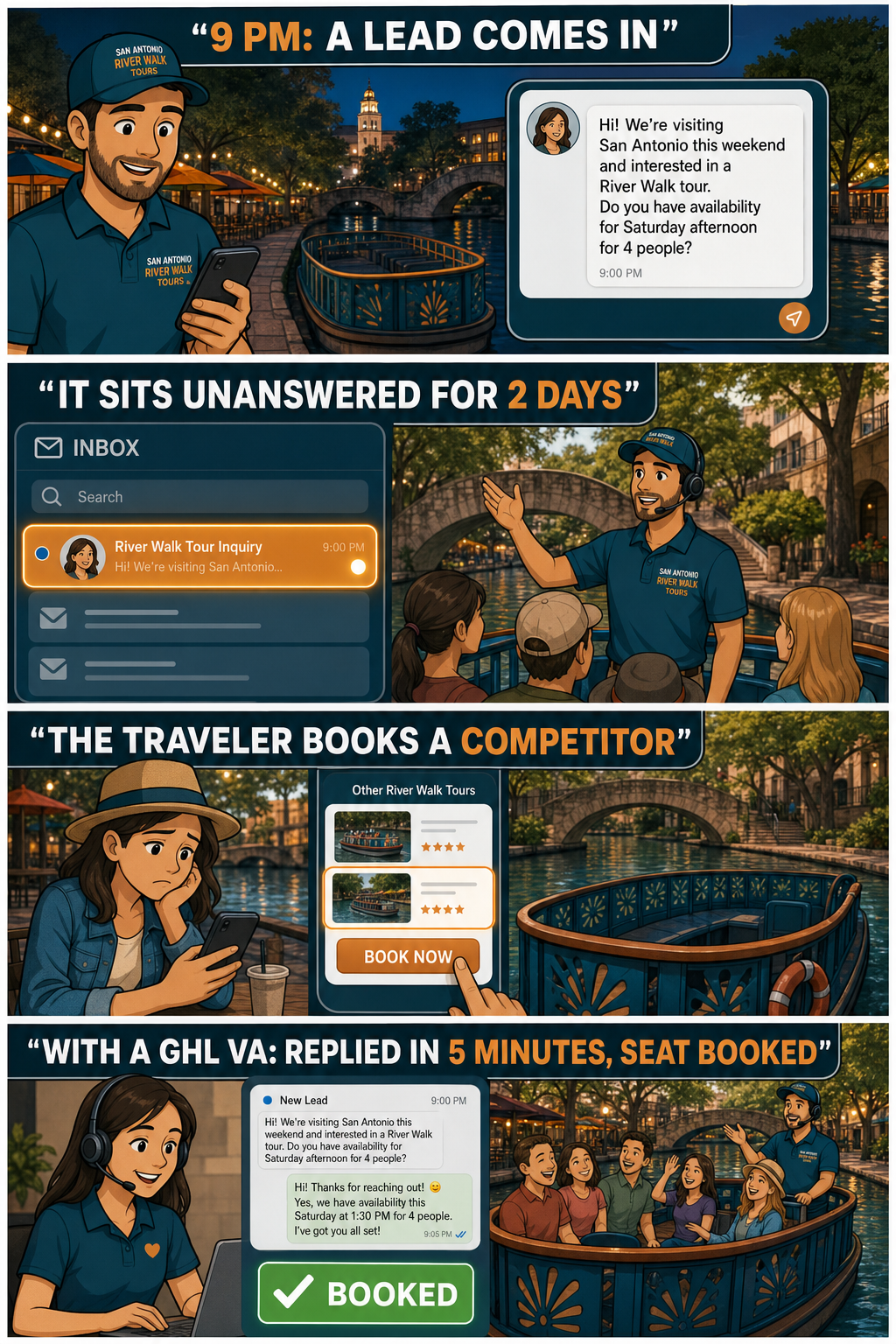
Same tours, two different back offices
A traveler DMs about tomorrow's ghost tour at 9 p.m. The message lands in an unmanaged GHL and waits. You see it at noon the next day; they've already booked elsewhere. Two no-shows hit the morning kayak tour because a reminder workflow silently paused. A glowing five-star review from last week still has no reply. Last season's food-tour guests never got the fall re-invite.
The 9 p.m. DM gets a warm, on-brand reply within minutes and a booking link — seat confirmed before bed. The reminder sequence is monitored, so the kayak tour runs full. Every new review gets a same-day response. Last season's guests get a segmented win-back offer, and a handful re-book. You find out in a Monday summary, not a fire drill.
What a GHL VA actually does, day to day
“Virtual assistant” undersells it. A trained GoHighLevel VA is part operator, part technician, part front desk. On a normal week for a San Antonio tour business, that looks like:
- Speed-to-lead response. Monitoring the pipeline and replying to new inquiries — form fills, Instagram DMs, Facebook messages, missed-call texts — fast, in your brand voice, with a booking link.
- Booking and deposit follow-up. Chasing soft holds, sending deposit links, and moving contacts through the pipeline so nothing stalls at “interested.”
- Review management. Replying to every Google review, requesting reviews from happy travelers, and flagging anything negative to you privately. (See how to get more 5-star reviews.)
- No-show prevention. Watching that reminder and confirmation sequences actually fire, and fixing them the moment they break.
- Win-back and repeat campaigns. Building segments and sending seasonal offers to past travelers at near-zero cost.
- Workflow upkeep. Adjusting departure times, updating calendars, cleaning tags, and telling you what to automate next.
If you’d rather the phone got the same treatment, this pairs naturally with an AI voice agent that answers every call 24/7 — the VA handles the judgment calls, the AI handles the volume. Together they make sure that in a city with 37 million annual visitors, no inquiry ever goes cold.
GHL VA vs. DIY vs. a full-time hire
There are really three ways to get GoHighLevel run properly. Here’s the honest comparison for a small-to-mid San Antonio operator.
| What matters | Do it yourself | Full-time in-house hire | Dedicated GHL VA |
|---|---|---|---|
| Monthly cost | “Free” (your time) | ~$3,500–5,000+ salary + taxes | From $700/mo |
| GHL expertise | You’re learning as you go | Must train them on GHL | Already trained on GHL + AI tools |
| Coverage | Whenever you get to it | 40 hrs, one person, PTO gaps | Managed, consistent daily coverage |
| Ramp-up time | Slow — it’s not your job | Weeks of hiring + onboarding | Days |
| Keeps up with GHL updates | Rarely | Only if you invest in it | Yes — trained on monthly updates |
| Risk if they quit | N/A | You’re back to square one | Covered by the agency |
DIY is fine until the business grows past your spare hours — which in a market this busy happens fast. A full-time hire makes sense at scale but is a big fixed cost and a training burden. For most operators, a dedicated GHL VA hits the sweet spot: real expertise, real coverage, without a five-figure monthly commitment.
The ROI math for a San Antonio operator
Let’s keep it concrete. Say your average tour books at $85 per seat and your typical booking is two seats — call it $170 per booking. A dedicated GHL VA on the entry plan runs $700/month.
That plan pays for itself if the VA recovers just about four bookings a month that would otherwise have leaked — one slow-reply inquiry saved per week. Given that the average unmanaged first response is 42 hours and replying in five minutes makes you 21× more likely to qualify a lead, “four saved bookings” is a conservative floor, not a stretch. Everything above that — the recovered no-shows, the re-booked past guests, the reviews that lift your ranking — is margin.
That’s the case in one line: in a city that hosts tens of millions of travelers a year, the cost of not having someone run your GoHighLevel is almost always higher than the cost of the VA.
How to get started
You don’t need to rebuild anything. If you already have GoHighLevel or the Tourism Snapshot, a VA steps into the account you have, audits what’s working, and starts plugging the leaks in the first week. If you don’t have GHL yet, we can set it up first. Either way, the goal is the same: turn a dashboard you feel guilty about into a booking engine that runs whether you’re at your desk or standing at the meeting point counting heads.
Start by telling us how your tours book today and where things fall through — talk to a real person, or see the full VA plans and pricing. If you’d rather see the whole automation system first, the Tourism Snapshot pricing page lays out what’s included.
Frequently asked questions
What exactly does a GoHighLevel VA do for a San Antonio tour operator?
A GHL VA runs your GoHighLevel account day to day: replying fast to new inquiries from forms, Instagram DMs, Facebook, and missed calls; chasing deposits and moving bookings through the pipeline; responding to every Google review and requesting new ones; making sure no-show reminder sequences actually fire; and building win-back campaigns for past travelers. They keep the automations tuned and tell you what to automate next — so the system fills departures instead of leaking them.
How much does a GoHighLevel VA cost?
Our dedicated GHL VA plans start at $700/month for the Growth plan (about 80 hours a month), with Power at $1,250/month and Elite at $1,500/month for more hours. There's also a pay-as-you-go option at $20/hour for one-off builds like a booking workflow or A2P registration. No contracts, no hidden fees, cancel anytime — see the Hire a VA page for full details.
Do I need to already have GoHighLevel or the Tourism Snapshot?
No. If you already have GoHighLevel or our done-for-you Tourism Snapshot, the VA steps into your existing account and starts optimizing it in the first week. If you don't have GHL yet, we can set it up for you first. The VA works with whatever stage you're at.
Why is a VA better than just buying the automation snapshot?
The snapshot installs the plumbing — pipelines, workflows, and templates. But automations still need a person to handle the edge cases (weather reschedules, group-size changes, late-night questions), approve review responses, fix workflows when they break, and press send on campaigns. The snapshot is the machine; the VA is the driver. Together they deliver the ROI; the snapshot alone tends to fall out of tune.
How fast can a GHL VA start responding to my leads?
Ramp-up typically takes a few days — long enough to learn your tours, voice, and pipeline. After that, the VA monitors inquiries during working hours for fast speed-to-lead responses. For true 24/7 coverage, most operators pair the VA with an AI voice agent and chatbot so every call and message gets an instant reply, with the VA handling the judgment calls.
Is this only for San Antonio tour operators?
No — we work with tour and activity operators across the USA. This guide is framed for San Antonio because it's a high-volume, high-competition market where speed-to-lead and review management make an outsized difference, but the same GHL VA service applies to any tour operator, travel agency, or activity provider.
About the author
Lucia Ontiveros is a Tour Operations & Automation Lead based in Santa Fe, New Mexico. She spent eleven years running guided desert and cultural day-tours across the Southwest before moving full-time into systems work, and has rebuilt the back office for small operators more times than she can count. She writes about the unglamorous machinery — booking funnels, deposits, reminders, and the people who keep it all running — that quietly decides which operators fill their departures. Her north star: automation should give operators their weekends back, not bury them in dashboards.
Editorial note: GHL Tourism Snapshot is a GoHighLevel automation and services product, not a travel agency. We don’t sell, book, or guarantee any tour. Statistics are drawn from the cited sources and reflect industry or study averages; your results will vary with your offer, market, staffing, and traffic.
Related posts
- AI Voice Agents for Tour Operators — the 24/7 phone coverage that pairs with a VA for judgment calls.
- Speed to Lead for Tour Operators — why the first five minutes decide the booking.
- Reduce Tour No-Shows — the reminder-and-deposit system a VA keeps running.
- Get More 5-Star Reviews — the review engine that lifts your local ranking.
- 6 Automations Every Tour Operator Should Run — where a VA fits in the full booking engine.
Ready to stop losing bookings to an unmanaged CRM? See Hire a VA, explore the full Tourism Snapshot pricing, or talk to a real person about your San Antonio tours.