
It is a blue-sky Saturday and your kayak group is halfway across the bay when a first-timer panics, flips, and grabs the next boat on the way down. Nobody drowns. Somebody dislocates a shoulder. Three months later a lawyer’s letter arrives, and the waiver you felt so good about collecting is the start of the argument, not the end of it. The question that decides whether you keep your business is boring: what insurance did you actually have in force that day?
Here is the short version. Nearly every tour operator needs general liability as the baseline. If you move people in a vehicle or boat, you need commercial auto or watercraft coverage, because your personal policy will not pay. If you have staff, including seasonal guides, you almost certainly need workers’ compensation. A certificate of insurance proves all of it, and permits, parks, and venues will not let you operate without one. This guide walks each policy, its cost, the paperwork that trips people up, and the five ways operators get it wrong.
What one uninsured claim actually costs
Picture the worst realistic day on your tour: a guest trips on a dock cleat, a van gets rear-ended, a bike brake fails on a hill. Now picture the bill. A single bodily-injury claim can run from a few thousand dollars for a sprain into six figures once surgery and a lawyer are involved. The general liability policy that covers it costs most small operators a few hundred dollars a year.
That is the whole trade. You pay a small, predictable amount so one unpredictable bad day does not end the business you spent years building. And it is a business worth protecting: the US Bureau of Labor Statistics counts 62,200 tour and travel guide jobs in 2025, growing 6% through 2035, while travel agent jobs sit flat at 0%. (BLS, guides) (BLS, agents) Direct bookings are the growth you cannot afford to leave exposed.
The coverage that actually matters
Brokers can name a dozen policies. Most operators need four, with two more depending on how they run.
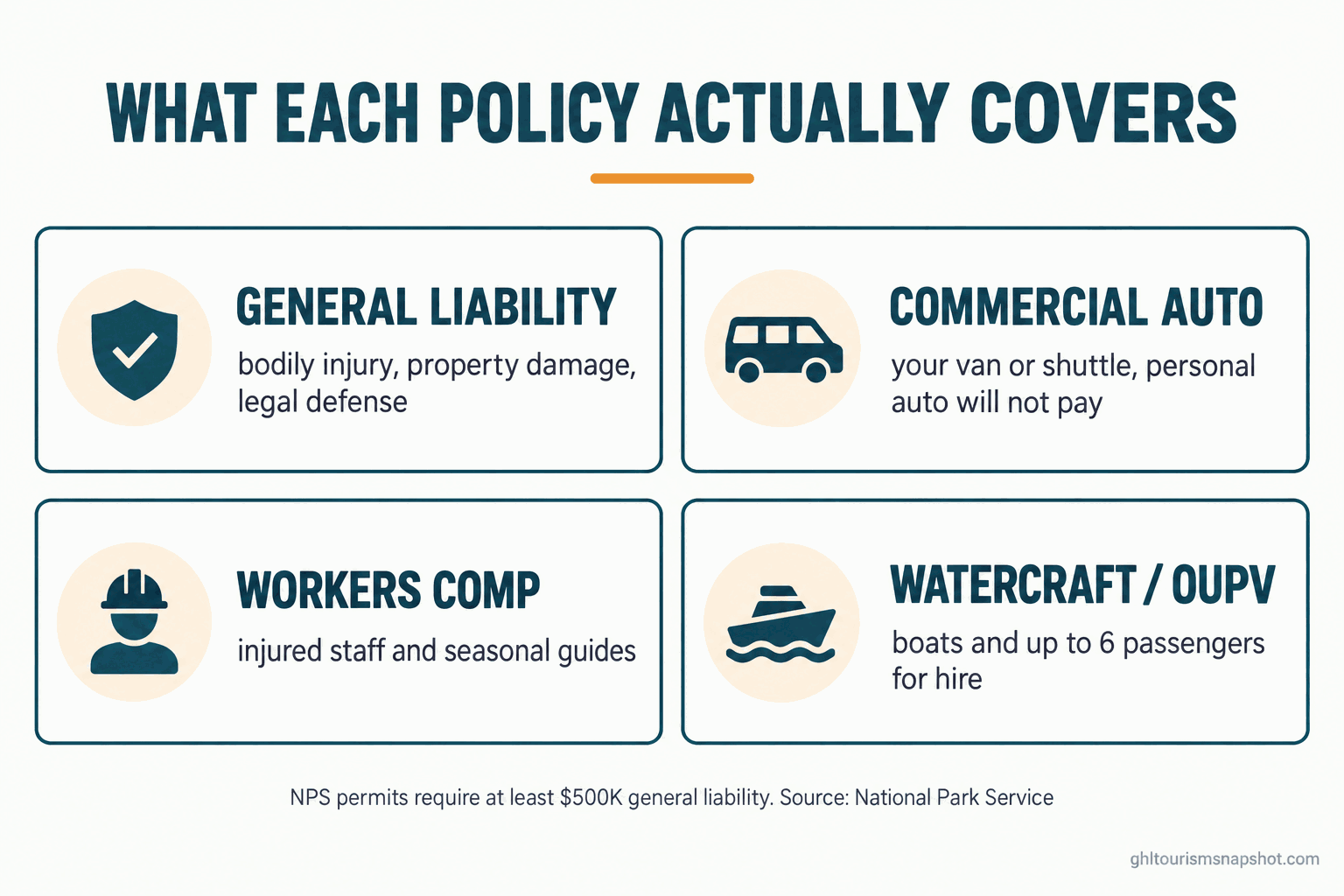
- General liability. Bodily injury, property damage, and medical expenses when the public gets hurt or their property damaged by your operation. The SBA calls it the coverage “any business” should carry. (SBA)
- Commercial auto. Vehicles you use to carry passengers or gear. A personal auto policy excludes this kind of business use.
- Professional liability (errors and omissions). Losses from a service mistake, which the SBA frames as “malpractice, errors, and negligence,” mostly if you sell or book other people’s travel. (SBA)
- Workers’ compensation. Medical costs and lost wages when a worker is hurt on the job. Most states require it once you have employees.
- Inland marine and equipment. The kayaks, bikes, and gear a standard property policy treats as “mobile” and excludes.
- Watercraft, or hull and protection-and-indemnity. Boats and the people on them, which liability and auto both exclude.
A business owner’s policy, or BOP, bundles general liability with property into one cheaper package, “an insurance package that combines all of the typical coverage options into one bundle.” (SBA) For many small operators, the BOP plus commercial auto is the whole stack.
General liability: the baseline everyone needs
If you buy one policy, buy this one. General liability responds when a guest is hurt or their property damaged on your watch, and it pays your legal defense even when the claim is baseless. The SBA lists it as protecting against “financial loss as the result of bodily injury, property damage, medical expenses,” plus libel, slander, and lawsuit defense. (SBA)
The cost is lower than most expect. Insureon reports a median general liability premium of about $29 a month, or $350 a year, for small service businesses in its travel category, and about $52 a month, or $621 a year, for a business owner’s policy that adds property coverage. (Insureon) Walking, food, and city tours that never touch a vehicle can often run on a BOP alone.
One warning: do not assume general liability covers the van or the boat. It does not. Those are separate lines, and the gap is where the expensive claims live.
Commercial auto and watercraft: the big one people skip
This is where operators get hurt, financially. The moment you put paying guests in a vehicle, your personal auto insurer is off the hook, and a claim from an accident on a tour can be denied. You need commercial auto, and it is the most expensive line most operators carry. Insureon puts the small-business average at about $245 a month, from the median cost of policies sold, with annual premiums ranging from under $375 to over $16,000. (Insureon)
Permits make this concrete. A National Park Service Commercial Use Authorization sets a $500,000 general liability floor and automobile liability minimums that climb sharply with how many people you carry. (NPS)
NPS Commercial Use Authorization minimum automobile liability per occurrence, in US dollars, by passenger capacity. Source: National Park Service.
If you run on the water, the rules change again. Carrying up to six paying passengers on an uninspected vessel requires a US Coast Guard OUPV, the credential the National Maritime Center describes as “limited to six or less passengers for hire.” (USCG) Carry a seventh paying passenger and you are in inspected-vessel and higher-license territory, with insurance to match. Your boat and the people on it are covered by watercraft or hull and protection-and-indemnity policies, not by general liability.
Workers’ comp, gear, and the policies in between
Three more lines matter, depending on how you run.
Workers’ compensation. The federal government, in the SBA’s words, “requires every business with employees” to carry workers’ compensation, and most states enforce it aggressively. (SBA) The trap for tour operators is seasonal guides. Calling a guide a “contractor” on a spreadsheet does not make them one if you set their schedule, hand them your gear, and tell them how to run the trip. A single injured guide you wrongly called a contractor can trigger back premiums, penalties, and an uncovered medical claim all at once.
Inland marine and equipment coverage. Your property policy covers the shop. It usually does not cover the ten kayaks on the trailer or the e-bikes in the van, because insurers treat movable gear as a separate class. If your tour depends on equipment that leaves the building, price an equipment floater so a stolen trailer does not cancel your season.
Umbrella or excess liability. This sits on top of your other policies and raises the ceiling. When a permit demands $5,000,000 and your base policy tops out at $1,000,000, an umbrella is the cheapest way to bridge the gap.
Certificates of insurance and “additional insured”
Buying the policy is half the job. Proving you have it is the other half, and it is where operators lose permits they already qualified for. A certificate of insurance, or COI, is a one-page summary your insurer issues showing your coverage, limits, and dates. Parks, venues, and partners all ask for one before you set foot on site.
Two details on that certificate do the heavy lifting. The first is additional insured status: when a venue asks to be named, they want your policy to defend and cover them too if your operation causes a loss on their property. The National Park Service requires exactly this, a CUA policy “must name the United States of America as an additional insured.” (NPS) The second is the limit, which has to meet or beat what the contract demands. A certificate showing $1,000,000 does not satisfy a permit that requires $5,000,000.
The quiet killer here is the expiration date. A COI is a snapshot, and most are good for a year. If a venue is holding a certificate that expired in February and your policy renewed in March, you are operating uninsured in their eyes, and one slow renewal can knock you off an approved-vendor list without a word. The fix is simple: track every certificate you owe a partner, and send the renewed version the day the policy renews, before anyone asks. That is one more back-office chore that lives better on a calendar than in your head.
Insurance versus a waiver: not the same thing
A lot of operators collect a signed waiver, file it, and feel covered. They are not. A waiver is a contract where the guest agrees not to sue you for the ordinary risks of the activity, and a good one reduces your exposure. But it does not pay a claim, it does not stop a guest from suing anyway, and courts in some states throw waivers out for gross negligence or sloppy language. Our liability waiver and e-signature guide covers how to write one that holds up.
Insurance is what pays when the waiver fails or does not apply. The two are a pair, not a choice. And the detail that surprises people: the National Park Service notes that some parks “do not allow use of a liability waiver form, insurance disclaimer, and/or indemnification agreement” for park trips at all. (NPS) In those parks the only thing between you and a claim is the policy.
Three operators, three insurance stacks
The right coverage scales with how you run, how many people you move, and where you operate. Here is the stack at three sizes.
The solo kayak guide. One person, a small group on the water, no vehicle beyond a personal truck and trailer. The core is a BOP for general liability, an equipment floater for the kayaks, and, the day a paying passenger steps onto a motorized vessel, a USCG OUPV plus watercraft coverage. If trips run in a national park or on federal water, the CUA sets the $500,000 floor and dictates the certificate. (NPS) Baseline cost is modest.
The mid-size food or city tour. Two or three year-round staff, seasonal guides, and a van that shuttles guests. A BOP is the base, commercial auto is now non-negotiable, and workers’ compensation kicks in the moment the seasonal guides are on payroll. Assume the $245-a-month commercial auto average is the single biggest premium line. (Insureon) Every hotel or venue partner will want to be an additional insured on a current certificate.
The large ATV or adventure fleet. Multiple vehicles, a dozen seasonal guides, high-risk activity, and operations that cross a permit boundary. The stack is high-limit general liability, fleet commercial auto, workers’ compensation, equipment coverage, and an umbrella to lift limits to the $5,000,000 a 26-plus-passenger permit can demand. (NPS) A lapsed certificate here is a shutdown.
Where this goes wrong
Five mistakes account for most of the uninsured-claim horror stories.
- Personal auto on a business vehicle. The premium saving is real until the first accident, when the claim is denied. If guests ride in it, it needs commercial auto.
- A limit below what the permit requires. A $1,000,000 policy under a $5,000,000 permit is not a smaller version of compliant. It is non-compliant, and the permit is void.
- Letting a certificate expire on a partner’s file. The coverage renewed; the proof did not. One slow certificate can drop you from an approved-vendor list silently.
- Calling seasonal guides contractors to dodge workers’ comp. If you control their schedule and gear, the state will likely treat them as employees, and an injured “contractor” becomes back premiums plus an uncovered bill.
- Treating the waiver as the whole plan. A waiver limits who can sue. It does not pay, and in some parks it is not even allowed. (NPS)
Objections, answered straight
“I’m tiny, do I really need all this?” You need less of it, not none. A one-person walking tour with no vehicle can often run on a single BOP in the few-hundred-a-year range. (Insureon) The size of your business does not change the size of a bodily-injury claim, and the smallest operators have the least cushion to absorb one.
“My booking software handles liability, right?” No. FareHarbor, Peek Pro, Rezdy, Checkfront, and the rest process payments and reservations. They do not insure you, issue certificates, or register your vehicles. Coverage is between you and an insurer.
“Can’t I just buy the cheapest policy and move on?” Price it against your actual permits and partner contracts first. The cheapest policy that fails a park’s $500,000 floor is more expensive than the right one, because it does not let you operate at all. (NPS)
Frequently asked questions
Tour operator insurance questions, answered
What insurance does a small tour operator actually need?
At minimum, general liability, which the SBA lists as covering bodily injury, property damage, and medical expenses. If you carry guests in a vehicle you also need commercial auto, if you run boats you need watercraft coverage, and if you have employees, including seasonal guides, you almost certainly need workers' compensation. Many small operators combine general liability and property into a single business owner's policy, or BOP.
How much does tour operator insurance cost in 2026?
It depends on your activity and vehicles, but Insureon reports a median general liability premium of about $29 a month ($350 a year) for small service businesses in its travel category, and about $52 a month ($621 a year) for a business owner's policy. Commercial auto is the big line, averaging about $245 a month for small businesses, with annual premiums ranging from under $375 to over $16,000.
Does my personal auto insurance cover a tour van?
No. Personal auto policies exclude business use like carrying paying passengers. If you have an accident on a tour while running a personal policy, the claim can be denied. You need a commercial auto policy on any vehicle used in the business.
What is a certificate of insurance and why do venues ask for one?
A certificate of insurance (COI) is a one-page document from your insurer that shows your coverage, limits, and dates. Parks, venues, and partners require it before you operate on their property, often asking to be named as an additional insured. The National Park Service, for example, requires a Commercial Use Authorization policy to name the United States of America as an additional insured.
Do I need a Coast Guard license to take passengers on a boat?
Yes. To carry up to six paying passengers on an uninspected vessel you need a US Coast Guard OUPV, which the National Maritime Center describes as limited to six or fewer passengers for hire. Carrying a seventh paying passenger moves you into inspected-vessel territory with a higher license and more insurance.
The bottom line
Back to that shoulder on the bay. The operator who sleeps through the lawyer’s letter had general liability in force, watercraft coverage on the boat, an OUPV in the captain’s pocket, and a current certificate on file with the park. That coverage cost a few hundred to a few thousand dollars a year. The uninsured version of the same day can end a business.
Insurance never fills a seat. But it is the floor the whole operation stands on, and the operators who take it as seriously as their bookings are the ones still running trips in ten years. Price your coverage against your real permits and partner contracts, get the certificates issued correctly, keep the renewals on a calendar, and pair every policy with a waiver that holds up. Then get back to the part that fills buses: driving direct bookings and keeping your departures full.
Related reading
- The Liability Waiver and E-Signature Guide for Tour Operators
- Tour Operator Compliance in 2026: Seller of Travel, TCPA Texts, Email & Waivers
- Do You Need a Seller of Travel License? A 2026 Registration Guide
- Chargebacks for Tour Operators: How to Stop Disputes and Win the Ones You Fight
This article is general information for tour operators, not legal or insurance advice. Coverage needs, costs, and requirements vary by activity, vehicle, state, and permit. Confirm your obligations with a licensed insurance broker and the relevant permitting agency before you rely on anything here.